

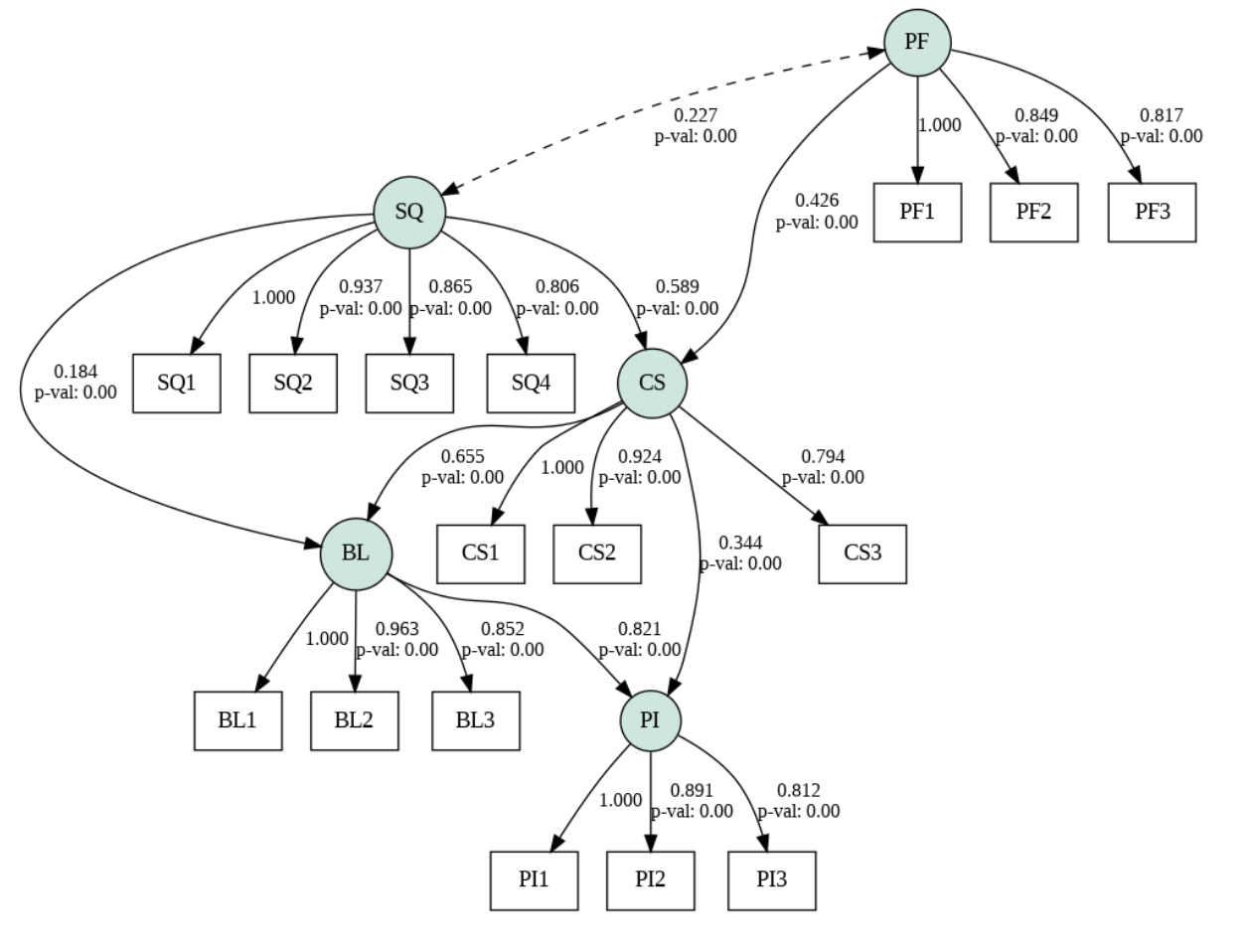
In the world of data and decisions, not everything that counts can be counted. Imagine standing beneath a grand orchestra, hearing the music swell — yet seeing only the violinists, never the conductor who guides them. Structural Equation Modeling (SEM) is that rare lens that helps us detect the invisible conductors — the latent (unseen) forces — shaping what we can observe. While regression shows us the notes, SEM helps us hear the symphony.
For modern analysts and learners in any data scientist course, mastering SEM is like learning to read both the score and the emotion behind the music — a skill that transforms how one interprets the hidden relationships between complex variables.
1. The Hidden Architecture of Meaning
Think of SEM as the architectural blueprint of human and system behavior. You can see the building (the outcomes) but not the beams that support it (the latent variables). In business, psychology, and even education, these hidden structures define what we measure. For example, “customer loyalty” isn’t directly visible, but we infer it from measurable cues — repeat purchases, social media mentions, and satisfaction scores.
SEM allows researchers to model such abstract concepts and statistically validate the invisible threads connecting them. Unlike traditional regression, which assumes straight roads, SEM acknowledges that real-world data flows through complex networks — with circular paths, feedback loops, and intertwined variables.
In a data science course in Pune, learners often encounter SEM after mastering basic statistical modeling. The transition feels like moving from two-dimensional sketches to 3D architecture — suddenly, the invisible scaffolding of relationships becomes clear.
2. Latent Variables: The Shadows That Speak
Latent variables are like shadows — they can’t be touched, yet they reveal form and structure. In marketing, “brand perception” might be a latent construct influencing customer trust and purchase intention. In healthcare, “patient well-being” might stem from multiple measurable indicators: physical health, emotional stability, and treatment adherence.
SEM uses observed variables (measurable data) to infer these latent constructs. Imagine adjusting mirrors in a dark room until the reflected light finally reveals the outline of something unseen — that’s what SEM does with data.
To make this work, researchers define measurement models (how latent variables are captured) and structural models (how they relate). The combination produces a mathematical portrait of abstract concepts, one that mirrors the real world far more accurately than linear models can.
Students pursuing a data scientist course quickly discover that SEM isn’t just another technique — it’s a language for translating intuition into quantifiable models. It enables them to move beyond correlation and explore causation between intangible concepts.
3. The Logic of Cause in a Web of Correlation
Traditional statistics often stops at “what is related to what.” SEM goes further — it asks why. It tests causal pathways between variables, providing a statistical backbone for hypotheses that would otherwise remain speculative.
Consider how organizational culture influences employee innovation. Culture is not directly measurable, yet it affects motivation, which affects creativity, which in turn influences performance. SEM allows researchers to model these indirect effects and test whether the hypothesized pathways hold true.
This causal reasoning — blending theory, data, and structure — makes SEM a favorite among advanced analysts. Those who take a data science course in Pune are often drawn to this technique because it unifies the art of conceptual thinking with the science of quantification. It empowers them to build causal models that guide business decisions, not just describe them.
4. The Craft of Model Building: Balancing Fit and Insight
Building an SEM model is like sculpting from marble — each cut refines the structure, but over-chiseling risks losing meaning. The process begins with a strong theoretical foundation: you hypothesize how variables connect, then use data to test whether reality supports your vision.
Model fit indices — such as RMSEA, CFI, or TLI — tell you how closely your model resembles real-world data. But SEM isn’t about chasing perfect numbers; it’s about building models that make conceptual and empirical sense. A model that fits perfectly but tells no story is as empty as a beautifully tuned instrument with no melody.
Expert practitioners — whether in academia, marketing, or behavioral research — learn to read the tension between data and theory like an artist balancing symmetry and soul. That’s where the power of SEM truly lies: in its ability to unify structure and substance.
5. Why SEM Matters in the Data-Driven Era
In an age overflowing with data, SEM offers a deeper kind of intelligence — one that captures meaning, not just metrics. For businesses, it helps uncover what really drives loyalty, trust, or performance. For social scientists, it quantifies the invisible — attitudes, beliefs, intentions — turning qualitative concepts into measurable, testable insights.
For learners, especially those in a data scientist course, understanding SEM marks the transition from data handling to data interpretation. It’s where statistics meet storytelling, where the unseen becomes visible.
Conclusion: The Symphony Beneath the Surface
Structural Equation Modeling isn’t just another analytical tool — it’s a philosophy of seeing. It challenges us to look beyond what’s measurable and seek the unseen dynamics shaping outcomes. Like tuning an orchestra, it aligns data, theory, and intuition into a coherent melody.
In a world where data alone often drowns out meaning, SEM restores harmony. For anyone pursuing a data science course in Pune or mastering the craft of causal modeling, learning SEM is an awakening — an invitation to move from counting the notes to conducting the symphony itself.
Business Name: ExcelR – Data Science, Data Analyst Course Training
Address: 1st Floor, East Court Phoenix Market City, F-02, Clover Park, Viman Nagar, Pune, Maharashtra 411014
Phone Number: 096997 53213
Email Id: enquiry@excelr.com